top of page

Smart Human-centered Infrastructure, Embedded sensing & Life-course Dynamics

Structures as Sensors
Structural response contains information about the events and activities occurring within the built environment. SHIELD Lab research explores methods to detect, localize, and characterize impacts and human-induced events from vibration measurements, combining structural dynamics, probabilistic modeling, and signal processing to interpret complex structural responses. This work provides a foundation for reimagining the built environment as a source of information about the activities occurring within it.
Collaborators: ASSET LLC, SDII University of South Carolina, San Francisco State University
Selected Research Outputs:
MejiaCruz, Y., & Davis, B. T. (2023). Event reconstructing adaptive spectral evaluation (ERASE) approach to removing noise in structural acceleration signals. Experimental Techniques, 47(4), 827-837. https://doi.org/10.1007/s40799-022-00598-x
Davis, B. T., & MejiaCruz, Y. (2024). Locating Impacts Through Structural Vibrations Using the FEEL Algorithm Without a Known Input Force. Experimental Techniques, 48(2), 359-368. https://doi.org/10.1007/s40799-023-00662-0
MejiaCruz, Y., Caicedo, J. M., Jiang, Z., & Franco, J. M. (2023). Probabilistic detection of impacts using the PFEEL algorithm with a Gaussian Process Regression Model. Engineering structures, 291, 116255. https://doi.org/10.1016/j.engstruct.2023.116255

Human Mobility & Functional Dynamics
SHIELD Lab expands the role of the built environment from recognizing human activity to understanding human function. Our research investigates how movement-related signatures captured within everyday environments can reveal meaningful information about mobility, functional ability, and changes across the life course. Current directions include assistive device use, individualized mobility patterns, complex multi-occupant environments, and the translation of passive measurements into functionally and clinically meaningful indicators.
Collaborators: SDII University of South Carolina, San Francisco State University
Selected Research Outputs:
MejiaCruz, Y., Franco, J., Hainline, G., Fritz, S., Jiang, Z., Caicedo, J. M., ... & Hirth, V. (2021). Walking speed measurement technology: a review. Current geriatrics reports, 10(1), 32-41. https://doi.org/10.1007/s13670-020-00349-zMejiaCruz,
MejiaCruz, Y., Hainline, G., Lozada, J. M. F., Fritz, S., Caicedo, J. M., & Jiang, Z. (2025). Multimodal gait dataset with floor accelerations, inertial sensor data, and synchronized video from controlled walking trials. Data in Brief, 112322. https://doi.org/10.1016/j.dib.2025.112322

Multimodal Sensing for Complex Human Mobility
Real-world human mobility is complex. Multiple people, assistive devices, objects, and activities can generate overlapping and complementary signals within the built environment. SHIELD Lab develops multimodal sensing and computational approaches to understand these complex interactions, integrating structural vibrations with embedded and non-contact technologies such as radar and environmental sensors. Sensor fusion and data-driven modeling enable information about movement, posture, location, activity, and assistive device use to be combined across sensing modalities. This research seeks to move infrastructure-based monitoring beyond controlled environments toward the complexity of everyday life, with particular attention to individuals with functional limitations and the environments that support their safety, accessibility, and independence.
Support:
EPSCoR Research Fellows: NSF: Award Abstract # 2531622
Selected Research Outputs:
Mejia Cruz, Y., Roohi, M. “Disentangling and Classifying Real-Time Mobility Signals from Floor Vibration Mixtures.” 2026 Engineering Mechanics Institute (EMI) Conference, Boulder, CO, June 2026.

Materials for Smart & Resilient Communities
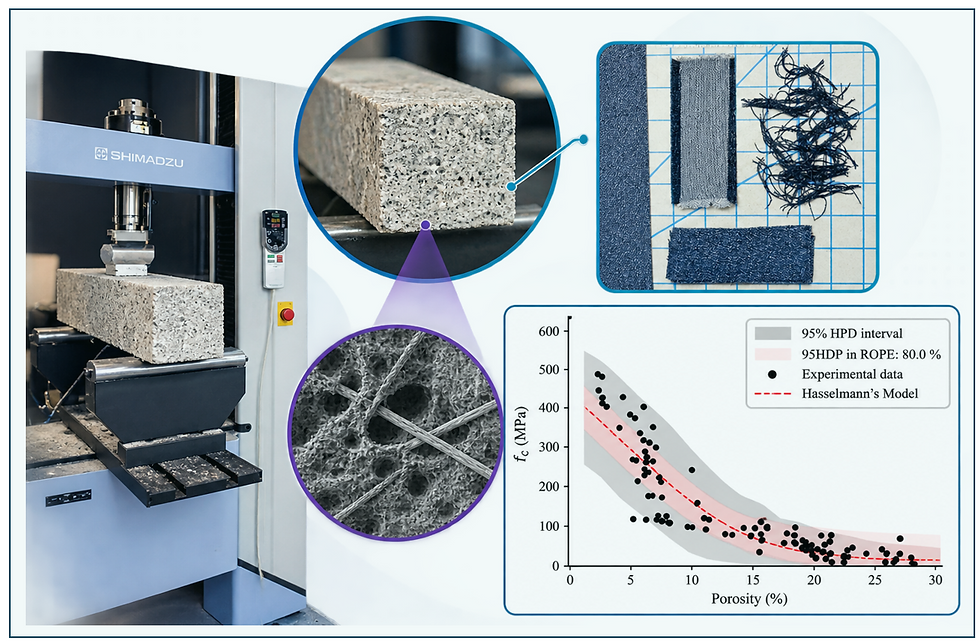
The infrastructure of the future requires materials that respond not only to engineering demands, but also to growing environmental and societal challenges. SHIELD explores the development and characterization of innovative infrastructure materials with an emphasis on sustainability, structural performance, and societal impact.
Previous research investigated the reuse of post-consumer materials in cementitious systems and their influence on structural and dynamic behavior. This work contributes to a broader research interest in innovative materials and technologies that can support more sustainable, resilient, and responsive infrastructure for the communities of the future.
Selected Research Outputs:
MejiaCruz, Y., Caicedo, J.M., and Matta, F. “Probabilistic Comparative Assessment of Structural Cement Composite Compressive Strength-Porosity Models”, ASCE Journal of Structural Engineering, vol 150, issue 11, 2024. https://doi.org/10.1061/JSENDH.STENG-13641
Hollingsworth, R., and MejiaCruz, Y. “Examination of the Dynamic Performance of Textile Reinforced Concrete with Post-consumer Waste Denim Fibers.” 43rd International Modal Analysis Conference (IMAC), Palm Springs, CA, January 2026.
bottom of page